A Unified and Automated Approach to Administrative Processes

We stand at the threshold of a new era in healthcare, marked by technological progress, shifts in healthcare practice frameworks, and the impact of a global pandemic on the intricate U.S. healthcare system.
Innovation in healthcare administration is not a distant dream anymore; it's a reality. AI and automation have stepped in and taken over those tasks that once bogged down our healthcare professionals by providing rapid, remotely accessible, and real-time solutions for provider onboarding, payer enrollment, licensing, and many more!
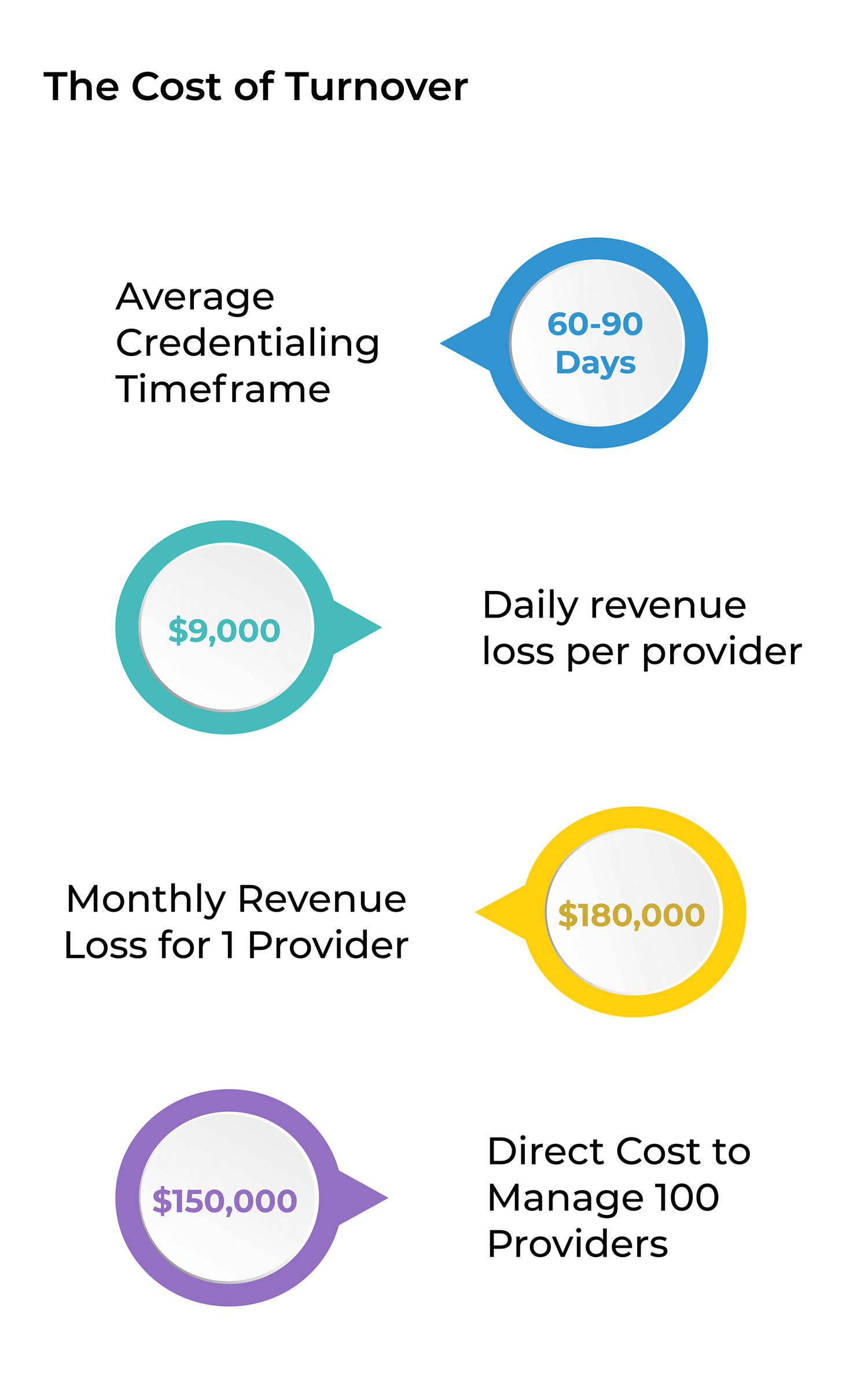
But here's the million-dollar question: Are health systems fully leveraging AI and automation to streamline their cumbersome administrative processes? A recent study found that a whopping 85% of provider credentialing applications have missing critical information which leads to 60-120 days of wasted time. And the financial impact? It’s harsh, costing health systems about $9,000 daily for each provider who is not able to see patients.
And if that's not enough to make you pause – nearly 17% of a physician's precious time is consumed by administrative tasks. Yes, you heard that right. Instead of providing patient care, physicians are navigating paperwork. Beyond just a waste of time, this shift away from patient care is a key player in the rising tide of physician burnout.
So, as we embark on this digital transformation journey in healthcare, the question remains – how can we better integrate these groundbreaking technologies into the American Healthcare System? The aim is clear: enhance administrative efficiency, cut down on those administrative burdens, and most importantly, allow our healthcare professionals to focus on what truly matters: providing exceptional patient care. Let’s dive into this together.

Healthcare professionals across the nation are grappling with the growing crisis of burnout. It's a topic that's not just important; it's critical, as it affects the very people we rely on to keep us healthy. Imagine being a physician today; it's not getting any easier. The relentless pressure, the mounting administrative tasks, and the sheer pace at which they're expected to operate are taking a toll.
The conversation around physician burnout isn't new, but it's becoming more urgent. The Medscape Physician Burnout & Depression Report 2022, paints a vivid picture of the situation. 47% of the physicians surveyed admitted experiencing burnout at the workplace.

One physician put it starkly, noting the overwhelming nature of their day-to-day: I barely spend enough time with most patients, just running from one to the next; and then after work, I spend hours documenting, charting, dealing with reports. I feel like an overpaid clerk.
It's not just the mental and emotional toll on doctors; it's the ripple effects this crisis has on patient care. 84% of physicians agreed that their state affects their relationship with patients in some way. A staggering 60% of physicians pointed to the endless bureaucracy as the main culprit for their burnout.
So, what's the way forward? The healthcare industry needs a shift – a move towards systems and processes that recognize the value of physicians' jobs to make their lives easier. This isn't just about improving healthcare; it's about safeguarding it for the future. At the end of the day, a healthy doctor is just as important as a healthy patient.
High provider turnover rates are a growing problem across the healthcare industry, especially after the pandemic that has intensified the situation. An article by Oracle threw out some staggering numbers related to provider turnover. Hospitals are seeing turnover rates of 19.5%, while at-home care providers and nursing homes are grappling with rates as high as 65% and 94%, respectively, in 2022.
Why are so many physicians leaving? The usual suspects include burnout, over-regulated processes, lack of mentorship, and a buffet of other workplace challenges that have providers hopping from one job to another, sometimes even changing fields entirely. Additionally, providers move between hospitals, health systems, and states throughout their careers. High turnover rates severely impose financial and operational burdens on hospitals and health systems which are already stretched thin to manage rising patient volume.
Healthcare administration teams operate in a high-pressure environment, especially Credentialing and Enrollment staff. These teams drive operational efficiency in health systems but face an uphill battle to keep the gears turning smoothly amidst such high turnover rates.
Onboarding providers is a complex process filled with tons of moving parts. The goal? To ensure healthcare providers can bill for their services without a hitch. But completing the enrollment process isn't as easy as it sounds. It demands a keen eye, a detail-oriented workflow, and proficiency that many people don’t realize.
Credentialing and enrollment teams verify provider information and process tons of payer enrollments. That’s the key reason why it is essential to have efficient and quick ways to perform credentialing and enrollment so that providers can see patients and start generating revenue sooner.
Healthcare organizations often underestimate the time it takes to complete payer enrollment. Many have yet to grasp just how demanding and information heavy these processes are. And if you don’t get ahead of it, two scenarios could play out:
First, you might find your new provider treating patients before they're officially enrolled with payers. Those services might not be reimbursed, translating to a direct hit to your revenue.
Second, you could end up turning away patients, which also comes with its costs. Once you send them away, the chances of them coming back are slim; they'll likely move on to another provider who's in their network.
So, start early, stay diligent. An automated and efficient onboarding process can benefit everyone involved.
Credentialing and enrollment teams juggle a multitude of tasks to onboard even a single provider. Before a provider joins a hospital or a health system, these meticulous teams dive deep into verifying credentials, double-checking education and training, ensuring all licensing and certification requirements are met, and vetting work history and professional references. Each task demands precision, persistence, and juggling multiple pieces at once. Why? Because every step is crucial in ensuring that providers are not just qualified on paper, but truly ready and able to deliver top-notch care to patients.
The task list to onboard one provider might look overwhelming to the untrained eye, but for these teams, it's all in a day's work. The work of a credentialing and enrollment team is vital to the success of any healthcare organization as they ensure that when we step into a provider's office, we're in capable hands. Let’s take a look at a credentialing and enrollment specialist’s task list to onboard ONE provider.
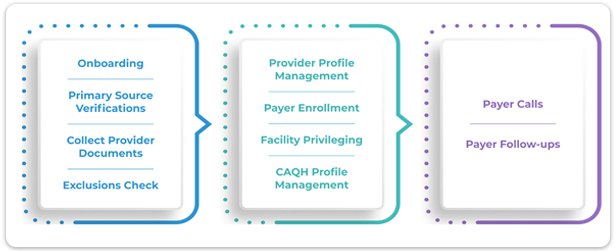
Completing every single payer enrollment is a cumbersome process, involving tasks such as filling out and submitting the application, confirming with the payer, maintaining consistent follow-ups, and responding to the final decision, whether it be approval, denial, or rejection.
Let's assume you have 250 providers in your health system and each provider needs to be enrolled with 10 payers on average.
Let's assume the average time to enroll one provider is 5 hours.
To complete 1,125 payer applications in a year, a credentialing or enrollment specialist would need to work 24 hours per day for about 235 working days out of 260.

A physician generates an average of $2.3 Million per year on behalf of their affiliated hospital. If there's a hiccup in getting that physician enrolled with payers, and they can't see patients for even one day, that's $9,000 that just evaporated. Imagine the impact over weeks or months! Two primary reasons cause these costly delays:
Healthcare organizations of all sizes face payer enrollment delays and it's clear that automating and streamlining this process is not just good practice – it's critical.

Every tick of the clock is a reminder when administrative delays create barriers to revenue flow for healthcare providers. In our rapidly evolving healthcare landscape, leaning into technology is essential. It lifts the weight of administrative tasks and paves the way for more efficient operations within health systems.
A unified and automated provider data management platform that pulls together provider data from various sources can dramatically shift how things operate. Automated workflows can streamline the credentialing, privileging, and payer enrollment maze, turning what used to be a slow and painstaking process into a swift and smooth operation.
The result? Payer contracts are set up in no time, providers can join networks faster, and the revenue starts flowing much sooner than before.
The key to unlocking faster credentialing and enrollment, and ensuring that providers start generating revenue quicker, is all about bringing everything together. Imagine having all your provider data in one place – every piece of information you need, just a click away. With a bit of AI and automation magic, you've got yourself a streamlined process that's not just fast, but also reliable.
Keeping tabs on provider credentials and licenses is a time-consuming process. By centralizing all this data, health systems can breathe a sigh of relief, knowing every provider is compliant and delivering top-tier care.
When all this crucial data lives in one unified and secure platform, those frustrating data silos are gone. Your teams will not just work faster; they will work smarter. They can get the full picture, enabling them to make quick decisions packed with insights. So, as we look at the big picture, it's clear that embracing a centralized and automated approach isn’t just a step forward; it's a leap into a future where healthcare operations are smooth and effective.
When you simplify the licensing process, it becomes a significant asset to your team, allowing you to provide quality assurance to patients and sail through the most thorough audits. The fragmented approach of the past will now be an agile and efficient process that sets the gold standard in healthcare administration.
With all provider licensing data at your fingertips, and automated workflows taking care of renewals, processes become streamlined and efficient. Providers can be onboarded swiftly and provide consistent quality care.
Automation streamlines provider data management, significantly reducing the risk of human errors and inaccuracies in provider information. The centralized approach guarantees that credentials and licenses remain current and in adherence with regulatory requirements.
A unified platform facilitates real-time monitoring of license statuses, guaranteeing timely renewals and ensuring that providers maintain active licenses while practicing.
With a holistic view of provider data, healthcare organizations can make informed decisions about recruitment, and more.
Through the implementation of an automated and streamlined credentialing process with a unified provider data management platform, the benefits are evident. This approach liberates staff from arduous administrative tasks, ensures providers experience a swift onboarding process, and guarantees that patients receive the high-quality care they are entitled to.
In the ever-evolving landscape of healthcare, maintaining a proactive stance is critical for health systems. With centralized and automated credentialing, health systems not only adopt a modern approach but also propel their teams toward an effective process that saves their time.
With all credentialing data accessible in one location, automated credential verifications, and renewals, providers can be onboarded rapidly, ensuring no lapses or non-compliance.
A centralized system provides a comprehensive overview of credential statuses, facilitating swift identification of any discrepancies or issues.
Reduced manual handling of provider data and organized system mean minimized errors. Accurate records lead to trustworthy credentialing data.
With all relevant provider data easily accessible, healthcare organizations can make strategic decisions about staffing and training.
By integrating an automated and unified system for payer contracting and enrollment, organizations transcend mere process streamlining; they revolutionize operations. What were once hurdles transform into prospects, lengthy waiting periods evolve into instantaneous analytics, and reduced denials pave the way for revenue expansion. With automated processes taking care of every step of the enrollment process, healthcare organizations transition from simply existing to truly excelling, empowering them to concentrate on their core mission: the delivery of exceptional patient care. Automating the enrollment and contracting process offers several key advantages:
Centralizing provider data streamlines compliance with all necessary requirements, resulting in decreased denials and more seamless negotiations for healthcare organizations.
Automated payer interactions foster timely and effective communication with payers.
Through automated enrollment, the onboarding process is expedited, facilitating the swift integration of new providers into the payer networks.
Real-time analytics enable health systems to monitor turnaround times, extract valuable insights, and enhance operational efficiency through process optimization.
Implementing proactive ongoing monitoring is crucial for ensuring compliance and mitigating risks effectively. Historically, monitoring providers has been labor-intensive, involving arduous certifications, intricate manual verifications, and constant communication. However, transitioning to automated ongoing monitoring presents a significant opportunity for health systems to streamline operations and enhance compliance protocols. A unified and automated solution empowers healthcare organizations to shift their focus towards patient care while efficiently managing compliance obligations. This shift towards automation not only promises increased efficiency but also reduces risks and unwavering commitment to excellence in healthcare delivery. The advantages of proactive monitoring are unparalleled in several key aspects:
Manual monitoring poses significant risks, primarily the potential for oversights. For instance, a failure to spot a lapsed license could lead to financial penalties and jeopardize patient safety. Automated monitoring serves as a safeguard by continuously verifying provider eligibility, thereby reducing such risks.
By directly tapping into primary sources like SAM, OIG, Medicare Opt-Out, and NPDB, automated systems eliminate the need for redundant checks. This streamlines workflows, enhancing overall efficiency within healthcare organizations.
Maintaining vigilance around the clock is essential in healthcare. Automated systems proactively alert healthcare organizations about any changes in professional status, license updates, or other relevant modifications in real time. This proactive approach ensures that crucial provider information is promptly attended to without any oversights.
Many healthcare organizations find comfort in sticking with the “we’ve always done it this way” mantra, relying on processes and systems that have been around forever. These age-old processes, while familiar, cost heavily to healthcare organizations. The manual licensing process is an incredibly time-consuming and resource-intensive task. Spreadsheet-managed provider data or data within multiple systems are highly prone to errors, and established processes are considerably limiting. These inefficiencies, errors, and missed opportunities pose a significant threat to patient care and must be addressed immediately.
Centralization isn’t just about tidying up provider data into one place; it’s a game changer. It’s about ramping up accuracy, making operations a breeze, and keeping healthcare organizations agile. Automation can cut down those endless tasks and ensure decisions are based on accurate and current information. The bottom line? The future is bright for healthcare organizations that are ready to shake things up, innovate, and pick solutions that propel them forward.