Most hospitals want to keep moving while maintaining accuracy. They want provider onboarding completed within a month and compliance to be error-free. With the right technology, they can make systems more efficient, but that does not always work for every platform. This guide will help you understand what works for healthcare and why they should invest in that.
This article helps you see what the best tools for automating provider verification are, what capabilities they should pay attention to, and how to look at the automation tools from a long-term ROI perspective. For this analysis, we will look at the practical returns, the impact on the organization, and the cost-benefit of the investment, with ProviderPassport being a top competitor.
The Importance of Verification Automation in Current Healthcare
Most hospitals use manual processes for data verification. Staff have to check and cross-check providers’ credentials everywhere, from emails to spreadsheets to payer portals to state licensing sites. Each step then requires tracking, following up, and repeating, which leads to delays. What looks like a simple background task becomes a frustrating bottleneck.
This has led to discussions with the top executives regarding the best tools for automating provider verification. Verification does not just stop at admin work but easily goes beyond that. It determines when a physician is able to start seeing patients and start billing for services. If physician onboarding is delayed due to manual verification, the hospital’s revenues are delayed as well. This is why investing in verification tools is essential today to speed things up.
At its most fundamental level, verification is a matter of trust. It confirms whether a provider is licensed, and it resolves issues surrounding board certifications, sanctions, and payer enrollments. It is necessary for hospital operations to run efficiently while maintaining accuracy.
The strongest tools for automating provider credential verification focus on three outcomes. First, they reduce repetitive data entry. Second, they shorten primary source verification timelines. Third, they keep provider records current without constant manual review. The goal is not to replace staff but to free them from chasing paperwork so they can focus on oversight and judgment.
When done correctly, automated verification supports compliance and financial stability at the same time. Clean data means fewer billing interruptions. Faster onboarding means providers become productive sooner. Administrative costs decrease because teams spend less time correcting preventable errors. Healthcare leaders evaluating the best tools for automating data verification should therefore look beyond feature lists. The real measure of value is whether the system improves verification accuracy, reduces onboarding time, and strengthens operational confidence across departments.
What to Look for in Verification Tools
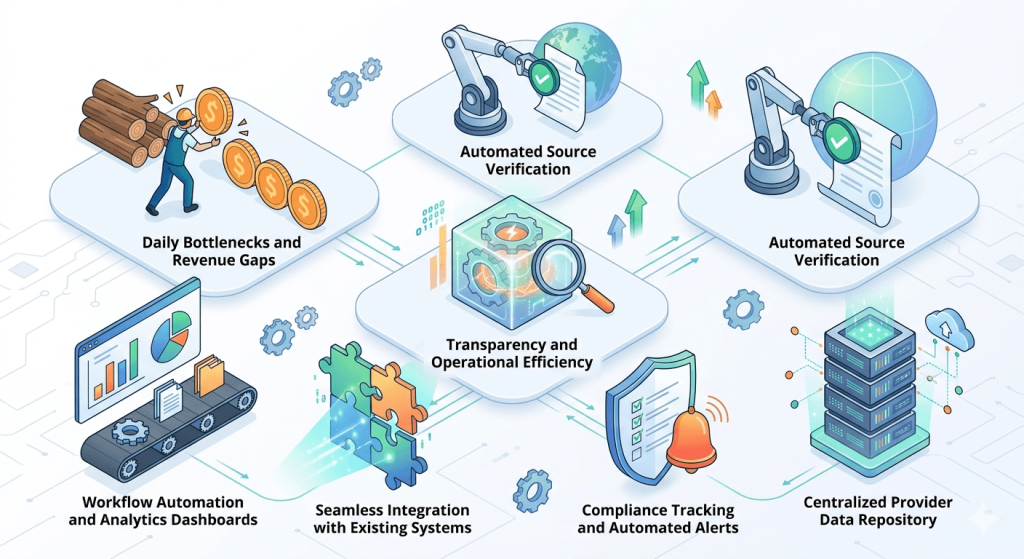
Identify Daily Bottlenecks and Revenue Gaps
When leaders evaluate the best tools for automating provider verification, the conversation should stay grounded in daily reality. What slows your team down today? Where do errors happen? Where does revenue stall because a file was incomplete or a license expired? Technology should solve those problems in plain, measurable ways. It should not add another layer of complexity. The goal is steady oversight, cleaner data, and fewer last-minute surprises that disrupt onboarding or compliance reviews.
Automated Source Verification
The first feature to examine is automated primary source checks. Strong verification software connects directly with state boards, certification bodies, and sanction databases. Instead of assigning staff to search websites and upload screenshots, the system completes those checks electronically and stores proof in one place. That alone can cut days or weeks from onboarding timelines. More importantly, it reduces human error. Direct verification from the source limits the risk of overlooking restrictions or expired credentials that could later create compliance exposure.
Centralized Provider Data Repository
Next, look for a centralized repository that strengthens data verification across departments. Many organizations still manage credentialing files in separate spreadsheets or shared drives. HR may hold one version of a verification record, while medical staff services hold another. Billing teams may rely on a third system. When data is scattered, inconsistencies follow. A centralized platform ensures everyone is working from the same, current record. It removes duplicate entries and reduces confusion about which information is accurate.
Compliance Tracking and Automated Alerts
Compliance tracking and automated alerts are equally important. The best tools for automating provider verification do more than just confirm a license once. They monitor renewal dates, sanction updates, and board changes continuously. Instead of discovering an expired credential during an audit, teams receive advance notice. That proactive oversight protects both patient safety and financial stability. It also supports smoother accreditation reviews, since documentation is organized and readily accessible.
Seamless Integration with Existing Systems
Integration is another practical requirement. These tools connect with systems your organization already uses. That may include CAQH ProView, EHR platforms, or payer enrollment portals. When systems communicate, data does not need to be reentered manually. This reduces transcription mistakes and speeds workflow. Provider verification flows directly into enrollment and billing systems, limiting the risk of mismatched records that delay claims.
Workflow Automation and Analytics Dashboards
Finally, leadership should look for workflow automation and reporting dashboards that bring clarity to verification progress. Visibility matters. Executives should be able to see how many providers are pending primary source verification, how long each stage takes, and where delays occur. Analytics make it easier to allocate staff time wisely and identify recurring bottlenecks.
Transparency and Operational Efficiency
At its best, automated data verification offers transparency. Teams know what is complete, what is expiring soon, and what requires follow-up. That clarity strengthens compliance, shortens onboarding, and reduces administrative strain. For healthcare organizations operating at scale, these features are not luxuries. These verification tools are practical safeguards that protect revenue and reputation.
10 Best Tools for Automating Provider Verification (Ranked & Reviewed)
Choosing a verification tool requires more knowledge than you know. Healthcare leaders need systems that reduce onboarding time, strengthen oversight, and support revenue without creating extra work. Below is a practical review of ten platforms worth considering, ranked by overall investment value and operational impact.

1. ProviderPassport — All-in-One Verification & Credential Automation (Top Investment)
For organizations seeking a comprehensive solution, ProviderPassport stands out among data verification tools. The platform automates document collection, license checks, and enrollment workflow tracking in one place. Instead of juggling multiple systems, teams manage credentialing, privileging, compliance monitoring, and provider data management through a single verification dashboard.
As one of the best tools for automating provider verification, ProviderPassport is built for scale. It supports large health systems that want to shorten time-to-revenue while maintaining oversight. Its structured workflows reduce manual follow-ups, and automated primary source checks strengthen verification. For hospitals looking to centralize operations and reduce administrative strain, this platform offers clear long-term value.
2. symplr Provider
symplr Provider is an enterprise-grade solution designed for complex health systems. Among the top-performing tools for credential verification, symplr centralizes provider records and supports committee workflows. Automated credential collection and recredentialing alerts help reduce delays.
Large organizations benefit from its structured oversight and compliance features. It is well-suited for systems that require formal review processes and strong documentation control within their verification programs.
3. Medallion
Medallion uses automation to complete forms, match documents, and execute checks in the background. Many healthcare organizations consider it a strong option because of how quickly it moves providers through onboarding. By reducing repetitive form entry and manual follow-ups, it helps providers become billable sooner and shortens the path from hire to reimbursement.
For growing healthcare groups, faster onboarding directly supports revenue stability. Medallion focuses heavily on reducing turnaround time while keeping records organized and accessible.
4. Modio Health
When evaluating the best tools for automating provider verification, Modio Health is a frequently cited option. Modio Health was built with input from physicians and credentialing professionals. It pulls license numbers, education records, DEA registrations, and NPI data into one profile. This supports accurate provider data verification without constant manual searches.
Its interface is straightforward, making it appealing for organizations that want a clean system without heavy customization. It works well for mid-sized systems seeking improved oversight without a complex implementation process.
5. Verisys
Verisys focuses on real-time credential checks and compliance monitoring. It verifies sanctions and exclusions continuously. For hospitals concerned about audit exposure, this added layer of security provides reassurance.
Its monitoring capabilities help reduce compliance risk while keeping provider records up to date. This makes it a strong supplemental solution for organizations prioritizing safety and regulatory alignment.
6. CredentialStream
CredentialStream offers enterprise credential management that scales with large systems. It is among the established tools for automating provider credential verification used by multi-facility organizations. The platform supports credentialing committees, peer review processes, and reporting needs.
For health systems with formal governance structures, CredentialStream provides structured oversight and documentation control that aligns with accreditation requirements.
7. MedTrainer
MedTrainer combines credentialing with compliance training and automated dashboards. It supports data verification and tracks required education and policy acknowledgments.
Organizations that value combining compliance oversight with credentialing workflows may find this integrated approach helpful. The reporting tools offer visibility into provider status and renewal timelines.
8. CureMD Credentialing
CureMD Credentialing is often considered by smaller practices seeking affordable but best tools for automating provider verification. These tools for automating provider verification include payer enrollment support and simplified workflow tracking.
For independent practices and community clinics, cost efficiency and ease of use are central. CureMD provides basic automation without the scale of enterprise platforms.
9. SpryPT
SpryPT focuses on clinic and therapy practice needs. It blends credentialing checks with billing support. It is tailored for smaller healthcare environments.
Its strength lies in verification and aligning provider records with billing readiness, helping small practices reduce payment delays tied to incomplete documentation.
10. QGenda
QGenda is primarily known for workforce management but includes credentialing features that support data verification. Its scheduling and staffing tools integrate with credential tracking, helping ensure that only cleared providers are assigned shifts.
For systems seeking combined workforce oversight and credential status visibility, QGenda offers a broader operational view for verification. Each of these platforms brings value in different ways. The right choice depends on organizational size, complexity, and long-term goals. The strongest investments centralize provider data, automate primary source checks, and provide clear reporting. When evaluating these tools, leaders should focus on measurable impact: faster onboarding, fewer compliance gaps, and reliable provider data verification that supports steady operations.
Summary: Choosing What’s Actually Worth the Investment
Not every platform delivers the same value. Hospitals need to look carefully at how much work a tool truly removes, how well it connects with existing systems, and how easy it is for staff to use every day. Depth of automation matters, but so does reliability and long-term support. ProviderPassport stands out as one of the best tools for automating provider verification. It brings verification, credentialing, and enrollment into one structured system. Organizations using it report less administrative strain and faster paths to reimbursement. Before investing, leaders should examine their current verification bottlenecks and choose a solution that directly solves those specific problems.